Tuesday, February 11, 2014

Planting Mustard and Kale

The cool winter weather is lingering in northern Florida and the home improvement centers have plants that are more suited for fall than spring.  The shelves are loaded with collards, broccoli, and cabbage.  The down side of planting the cold weather plants now is that they will not be harvested in time to give way for the spring garden.  However, I ended up with a 9-pack each of mustard greens and kale.

Mustard Plants
If I were to sow mustard seeds, they would take about 9 days to germinate and 50 -70 days to maturity.  The mustard greens are ready to plant and if nothing else, I will let them bloom to attract the neighbor's bees that he got during the recent cold spell.

I should have named the Back Forty the Serendipitous Garden because I never know exactly what to plant.  It depends on what is available at the garden centers. 

On the spur of the moment, I picked up kale.  Why?  I heard that Dr. Oz talked about it on his TV program, celebrities use kale in their smoothies, and kale is served in salads in fancy restaurants.

Kale
I have often mixed kale, mustard, and turnips in the garden and used the greens for cooking  Sometimes I have put them in the freezer after blanching, draining, cooling under running water, and packing the greens in quart size bags and put them in the freezer.

So the other day, I set out nine plants each of mustard greens and kale after turning the soil and making holes large enough to hold the plants.  They looked pretty nice in two straight rows.  Is this for the winter garden or for the spring garden?

Tip of the Day:  To prevent slugs from crawling up the plants and breaking off the stems, remove top and bottom from a small can or cut the same shape from a plastic bottle and set it down in the soil around your plant.   I have yet to try this myself but I have had many plants broken off in the past.

Thank you for visiting my blog. 

Monday, February 10, 2014

First Happy Anniversary

It's been a year ago since I started blogging about my garden,  yard, and "park".  It has been an interesting experience.  Some of my readers are in countries I never heard of and my blog has reached porn sites which really has surprised me. 

Initially, I just wanted to write or document what happened in my garden and back forty.  It was never my intention to tell you how to garden.  You are free to garden any way you want.  I wanted to keep a journal of what was going on in my back yard and sharing the information.

When I write my blog, I wobble between I and we.  I start out with I and all of a sudden there is the "we".  Who are the "we"?  It is my husband and I, he, and we do so much together; so the we is I and the I is we.  Now, I would worry when my "shadow" comes along too.


Evelyn Rose
Blogging has kept me busy and interested in researching gardening and so much that goes along with it.  I stated in my first blog that I was an avid gardener--I never said that I was a good gardener.

I do want to thank you for adding me to your circles.  I wish that I could add you to mine, but I really don't know how.  You do. 

As a token of my appreciation, please accept this very special rose.

Thank you for visiting my blog.  Do it again.

Thank you. 
Thank you. 
Thank you. 


Sunday, February 9, 2014

A Hard Night's Day

My lover and I have been working like dogs in the garden all day long but when we go inside and we hold each other, everything is all right. We are working hard in the garden to put food on the table, to share vegetables and fruit with family and friends.

We work hard in the garden day after day, weather permitting.  We are fair weather gardeners you might say but when we stay inside on a cold winter's day and we hold each other, everything is all right.

We have dismantled the bed, who needs it?  We dismantled the raised bed in the garden.  I found myself wondering what the heck to plant in that box.  I felt restrained and boxed in.  The raised garden box limited my movements when turning the soil.  I don't like to feel boxed in; I want to move freely; roam; and plant my vegetables anywhere and everything will be all right.

After a hard day's work in the garden, my back aches but when my lover of many years hold me tight, I feel all right.  My dearest husband, my lover, and I work hard all day and all night.  We work hard for each other.  We take care of each other and everything will be all right.


Thank you for visiting my blog that today is based on Beatles' first visit to this country and appearing on Ed Sullivan's show.

Friday, February 7, 2014

The Frozen Hibiscus

The hibiscus is a large deciduous shrub or small tree depending on how it is pruned.  The tree or bush with its dark shiny leaves may grow to 15 feet in frost free areas.  It likes full sun and well-drained soil.  Once established it requires  very little care.  The blooms are trumpet shaped and come in a variety of color and color combinations.


A Frozen Hibiscus
I had a beauty of a hibiscus at the corner of the porch and I often thought about pruning it but never did.  It grew into a tall bush.  Now I know that I could have pruned it into a single stemmed small tree but I let it grow any way it wanted and it turned into a nice shape with lots of huge red flowers that lasted for a long time.

I had hoped that this tropical bush was well protected near the house and under a large pine tree's branches but the temperature went below 30 degrees F for an extended time.  The hibiscus dropped its flowers and turned brown in a few days.  It was recommended that I leave it alone to give it a chance to recover.  Maybe it was still alive under all those brown leaves.  What to do now?

I have left it alone for several weeks and I have not seen any greenery.  It is recommended that the hibiscus be pruned in early spring under normal circumstances but this winter has been far from normal.  It is misting this morning so I will wait for a sunny day to do any pruning.  Then I will find out the extent of the freeze damage.  Hopefully, the roots are still alive and it will grow again.

I have signed up for the A to Z Blog Challenge for 2014, have you?
Thank you for visiting my blog.

Thursday, February 6, 2014

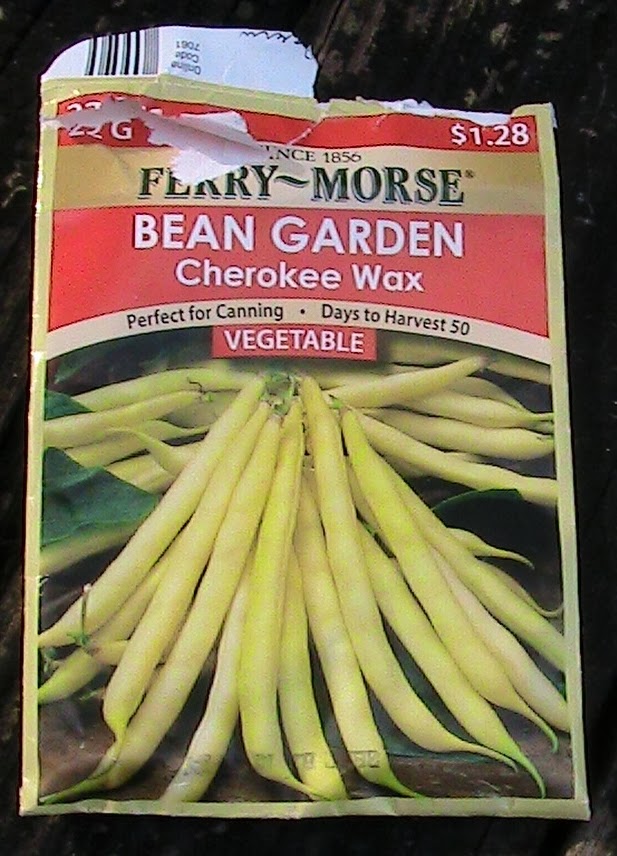
Cherokee Wax Beans

One of the easiest and earliest vegetables to plant is beans.  For my Bean Garden, I have chosen the Cherokee Wax Bean that germinates in 7 to 10 days and reaches maturity in 50 days.  I space the seeds about 2 inches apart and one packet of Ferry-Morse seeds fills a 10 foot row.  Soaking the beans overnight before planting will speed germination.

I added compost from my pile and turned he soil, smoothed it out with a hoe, and raked the area to remove sticks, clumps, and the ever present dollar weed.  With my rake handle, I made a small trench about an inch deep, planted the seeds, and covered them.  The soil was moist from an early morning shower and the weatherman predicted more showers.

The yellow Cherokee wax beans, about 5 to 6 inches long when mature, are supposed to be "stringless" and very productive.  Since I planted the beans rather early in the season, I learned that the beans can "withstand adverse weather condition."  They are also disease resistant. 

The beans are great for freezing (and canning).  I blanch them quickly, chill them under cool running tap water and let them drain.  I pack them in quart size bags and store them in the freezer for use later.

Ferry-Morse claims that the Cherokee Wax Beans "tastes great right out of the garden."  Does that mean that the beans are edible raw in the garden, that I can pick 'em and nibble on 'em? 

Cultivating the beans is minimal.  I have found that in my already established garden, weeding around the beans is hardly necessary.  The beans plants will crowd out the weeds. 

To fertilize, I side dress with a common garden fertilizer such as 6-6-6 or 8-8-8 when the beans have established themselves.  I put fertilizer down on each side avoiding getting it on the leaves that will cause "burns".

The yellow Cherokee Wax Beans are the first of the beans sowed in my Bean Garden and I am looking forward to the harvest.  It's been a long time since I planted wax beans

I have signed up for the A to Z Blog Challenge for 2014, have you?
Thank you for visiting my blog.

Tuesday, February 4, 2014

Mustard Greens

The mustard green is a Southern favorite but I did not plant it last fall nor during the winter season; however, thanks to my compost pile, some of the mustard seeds survived and sprouted here and there and produced huge green leaves.  I left them alone thinking they were too bitter to eat. 

Mustard Greens
I couldn't resist picking some of the large leaves, cook them and eat them. To my surprise they were sweet and delicious. 

To my knowledge, the greens contain vitamins A and K, carotene, and are filled with cancer preventive and anti-inflammatory properties.

I was going to leave them alone and let them produce their bright yellow flowers that the bees and butterflies love. 

The flowers form an abundance of small pods filled with seeds that may be ground into powder and used as a base for mustard.

Checking my planting schedule for northeast Florida, I found that February is a good time to plant mustard seeds at 1/2 inch deep in rows 1 and 1/2 to 2 feet apart.  The mustard plants become rather large when side dressed with nitrogen rich fertilizer to stimulate the growth of lush green leaves.  The seeds germinate in about nine (9) days and mature in 50 - 70 days.

It also helps to mulch to keep the soil moist and to water only when necessary.  It is recommended to weed and thin the plants as soon as plants emerge.  Why fertilize weeds?

To harvest, start picking young leaves to use raw in salads (I'm not there yet).  I do like to cook my mustard greens and serve them with last summer's home made watermelon rind pickles.  Mustard greens, after removing the thick stems, will freeze well after blanching, cooled under running water, and packed in plastic quart size plastic bags, and stored in the freezer.

The mustard green is the first vegetable I plan to direct sow in my spring garden, harvest some, and let some go to seeds for the bees I hope will visit and help with my garden.

I have signed up for the A to Z Blog Challenge for 2014, have you?
Thank you for visiting my blog.

Sunday, February 2, 2014

Groundhog Day

If the sun shines in Pennsylvania tomorrow and the groundhog sees his shadow, there will be six more weeks of winter and that is official.  So they say.  The weatherman said that we had twenty two cloudy days last month in northeast Florida which is still part of the Sunshine State.  What a miserable winter!  If the groundhog was here on the beach, he would not see his shadow. 

I broke out of my heavy coat and tossed my gloves and went out to survey the winter damage on the Back Forty.  The potatoes are busting through the pine straw and I hilled them up.  I cut away the dead branches from the Plumbago and noticed that it was putting out healthy greenery along the ground that will be good for transplanting.  The shefflera or the Umbrella plant is pretty much gone but I am not ready to start cutting and pulling it up yet.


First Azalea Bloom for this Spring
I weeded around the island where I had trimmed the Cassia and added more pine straw to hold the dirt in place.  I continued to make a shallow trench around the azaleas that were full of buds.  Spring is coming!

I found one, yes only one, single pink azalea bloom and that, my friends, is the official declaration that Spring is here.  It has arrived.  Time to go gardening.


I have singed up for the April 2014 A to Z Blog Challenge, have you?
 Thank you for visiting my blog.